
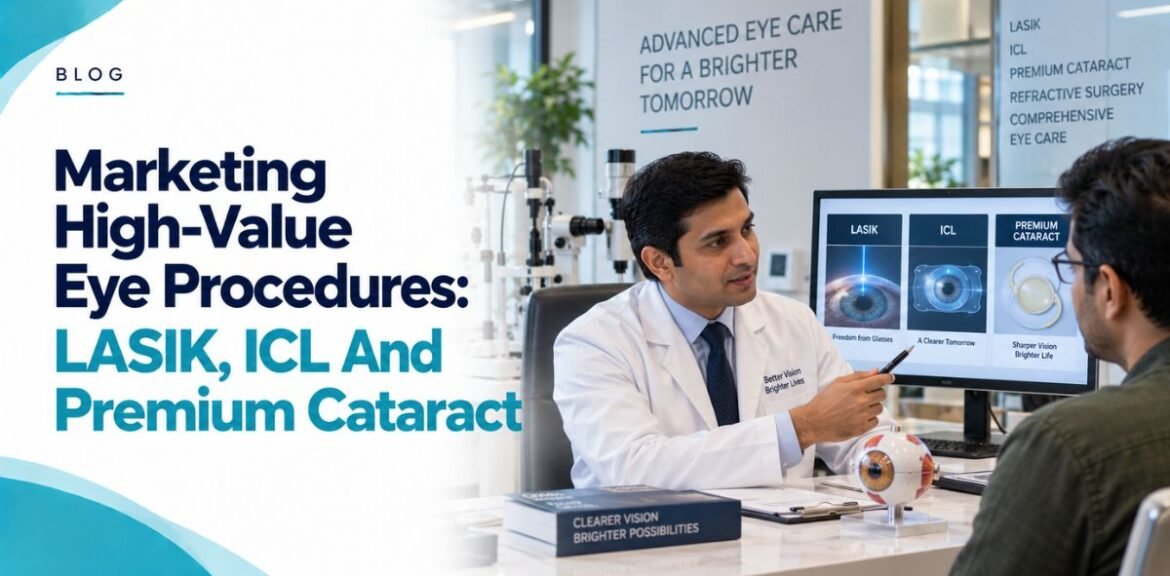

Two eye clinics can run the same number of surgeries and earn very different revenue. The difference is case mix. Routine OPD and scheme cataract keep the lights on; LASIK, ICL, and premium-lens cataract build the practice. This guide is about marketing that deliberately attracts the high-value, self-pay patient.
How Do Eye Clinics Market High-Value Procedures Like LASIK And Premium Cataract?
Eye clinics market high-value eye procedures by targeting the intent and audience for elective, self-pay work rather than routine care, positioning on outcome, technology, and surgeon expertise instead of price, building deep trust content for a big decision, and offering financing to remove the cost barrier. The goal is a case mix weighted toward LASIK, ICL, and premium-lens cataract, which lifts revenue per patient without adding OT load.
Also Read – How To Get More Eye Clinic Patients Online In India
Why Case Mix Beats Raw Patient Count
Chasing more patients is the obvious move, but more low-margin cases mostly add work, not profit. Shifting even a modest share of your volume toward high-value eye procedures can transform the numbers, because one LASIK or premium-IOL case can be worth many routine visits. Market for the case mix you want, not just the footfall you can get.
Target Elective, Self-Pay Intent Specifically
Routine and premium patients search and behave differently. Someone Googling “free eye check-up” is not your LASIK patient. Build campaigns around the searches and audiences tied to elective procedures: LASIK for people tired of glasses, ICL for high-power eyes unsuitable for LASIK, premium lenses for cataract patients who want spectacle independence. Speak to the specific desire, not eye care in general.
Also Read – Local SEO For Eye Clinics: How To Rank On Google Maps
Position On Outcome And Trust, Never Price
High-value, self-pay patients rarely pick the cheapest clinic, they pick the one they trust most with their eyesight. Lead with the outcome (life without glasses, sharp vision after cataract), the technology, and the surgeon’s experience and case volume. When you compete on price you attract price shoppers; when you compete on trust you attract the patients who happily pay for premium work.
Also Read – Google Ads Vs Meta Ads For Eye Clinics
Build The Trust Content A Big Decision Needs
- Expertise: Surgeon profiles with credentials, experience, and case volume.
- Real Results: Honest, permission-based patient stories and outcomes for each premium procedure.
- Education: Clear explainers on what the procedure is, who it suits, and what to expect.
- Technology: The technology and lens or laser platforms you use, in plain language.
Remove The Cost Barrier With Financing
Price is rarely the real objection for a premium procedure, but a large one-time figure can stall a ready patient. Clear EMI and financing options, presented early, let a convinced patient say yes now instead of postponing. Make financing visible on landing pages and have counsellors raise it before the patient has to ask.
Align Counsellors To The Premium Conversation
Marketing brings the high-value patient to the door; the counsellor closes them. If your team defaults to quoting the cheapest option or the base package, your premium marketing leaks at the last step. Train counsellors to understand and present the value of ICL or premium lenses so the conversation matches the promise the ad made.
Also Read – How to Reduce Price-Shopper Leads for Eye Clinics
Measure Revenue Per Patient, Not Just Leads
When the goal is case mix, track the metrics that reflect it: share of high-value procedures, average revenue per patient, and cost per qualified consultation for premium campaigns. A campaign that brings fewer leads but a richer case mix can be far more profitable than one that maximises raw volume.
Package The Value, Do Not Just Quote A Price
How you present a premium procedure changes how patients judge its cost. A bare per-eye figure invites price comparison; a clear package that spells out the technology, the surgeon, the pre and post-op care, and the follow-ups reframes the decision around value and safety. For LASIK and premium cataract, patients are buying a lifelong outcome for their eyes, not a line item, so the presentation should reflect that. Show what is included, why it matters, and what sets your clinic apart, then let financing handle affordability. When the value is packaged well, the premium option feels like the sensible choice rather than the expensive one, and your counsellors have a far easier conversation to close.
Also Read – Eye Clinic Marketing
Want More LASIK, ICL And Premium Cases?
Tycore builds procedure-specific campaigns and trust content that attract high-value, self-pay eye patients across India, tuned to the case mix that grows your practice. Get a free eye clinic lead audit.
Book A Free Eye Clinic Lead Audit
Frequently Asked Questions
Target the specific intent and audience for LASIK, position on freedom from glasses and outcome, and qualify leads so counsellor time goes to serious, self-pay patients.
Usually yes. Different intent, message, and audience mean separate campaigns perform better and let you measure the case mix each one delivers.
Often, yes. It removes the one-time cost shock and lets a convinced patient proceed now. Presenting it early, before the patient asks, tends to work best.
Yes, because ICL cases are high value and serve patients LASIK cannot. Demand-generation on Meta and education content usually work better than search alone for ICL.
Pingback:How to Reduce Price-Shopper Leads for Eye Clinics
Pingback:How to Get More Eye Clinic Patients Online in India (2026)