

Home improvement companies often pick one ad platform and blame it when results disappoint. The truth is that Google Ads and Meta Ads do two different jobs. Understanding which does what, and when, is how you stop wasting budget and start booking real projects.
Should a home improvement company use Google Ads or Meta Ads?
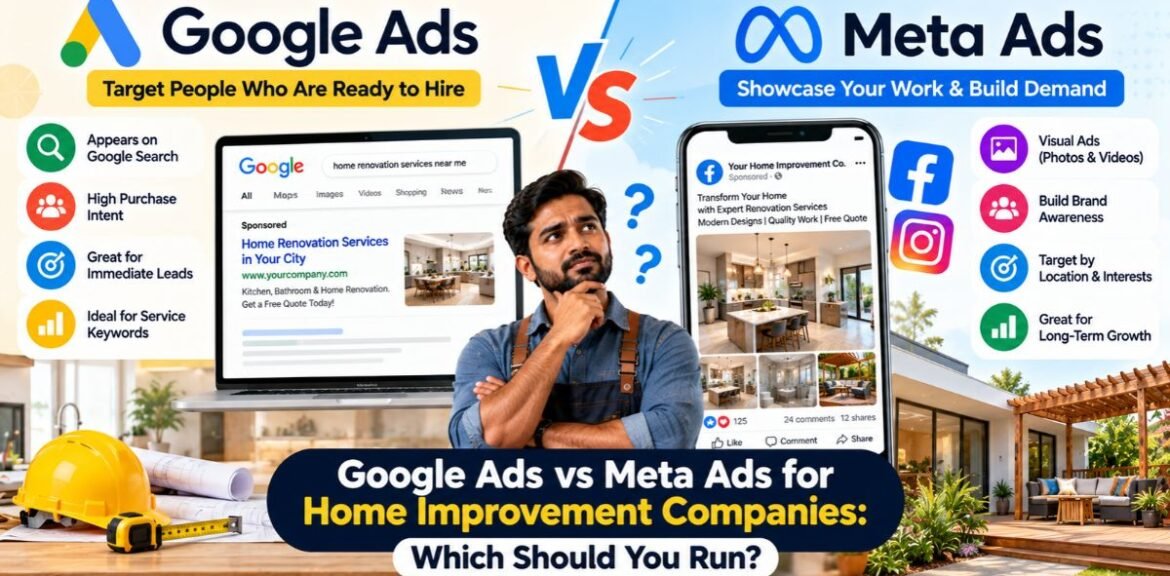
Use Google Ads to capture homeowners already searching for the work, which brings the highest intent and fastest enquiries. Use Meta Ads to build awareness and retarget homeowners planning projects, using strong before-and-after visuals. Most home improvement companies need both: Google for demand capture, Meta for demand creation and retargeting.
Two platforms, two different jobs
Google Ads captures demand that already exists, homeowners searching for a specific job right now. Meta Ads creates and nurtures demand, reaching homeowners as they scroll and staying in front of those still dreaming about a renovation. Treating them as interchangeable is the core mistake. They work best as a pair, each doing the job it is built for.
Google Ads: capturing high-intent project searches
When someone searches kitchen renovation contractor, bathroom remodelling cost, or waterproofing near me, they are close to hiring. Google Ads puts you in front of that high-intent moment. It is usually the fastest route to enquiries, though also competitive, so keyword choice, service-specific landing pages, and a fast quote path all matter. Expect a higher cost per click, offset by much higher intent and better conversion into real jobs.
The details decide whether Google Ads makes or loses money for a home improvement business. Sending every click to your homepage wastes budget, each service needs its own landing page that matches what the homeowner searched for. Negative keywords matter just as much, filtering out job seekers, DIY searches, and services you do not offer keeps you from paying for clicks that never book. And because these clicks are expensive, call tracking and a fast response are not optional, a lead you paid good money for and never called back is money set on fire.
Meta Ads: awareness and retargeting that sells the transformation
Home improvement is a visual, aspirational purchase, which is exactly what Meta Ads do well. Strong before-and-after images and short project videos catch homeowners who are dreaming about a change but have not searched yet, and retargeting brings back those who visited your site or gallery but did not enquire. Meta is also strong for promoting seasonal offers to a local audience. Creative should show the quality of your work, because the transformation is your best salesperson.
Which should you start with?
If your budget is limited, start with Google Ads to capture the homeowners already searching, because that intent is closest to a signed job. Once you have enquiries flowing and tracking in place, add Meta Ads for awareness and retargeting to widen the top of the funnel and stay in front of homeowners who are still in the planning stage. This order matters, capturing existing demand first gives you quick wins and revenue to reinvest, while jumping straight into awareness ads can burn budget before you have proven the funnel converts. Prove that homeowners who reach your quote form actually book, then spend to fill the top of that funnel with more of them.
How to split budget as you scale
A common progression is to lead with Google for demand capture, then shift a growing share to Meta as you build awareness and retargeting audiences and a library of project visuals. There is no fixed ratio, let cost per booked job guide the split. Move budget toward whichever platform is producing real, profitable projects for your business, and review it against seasonality every month.
Common ad mistakes that waste home improvement budgets
A few mistakes drain home improvement ad accounts more than anything else. Running ads with no landing page and no lead tracking, so you cannot tell what worked. Using stock photos instead of your own project work, which kills the trust that sells the job. Pausing campaigns the moment they do not book in the first week, before they have had time to gather data. And treating slow follow-up as separate from the ads, when in reality every unanswered lead makes your whole ad spend look worse than it is.
Seasonality is the other trap. Home improvement demand rises and falls with weather, festivals, and budgets, so a ratio or budget that worked in one season can quietly waste money in another. Plan spend around your busy and quiet periods, lean into demand when homeowners are ready to act, and use quieter months to build the awareness and retargeting audiences that pay off when demand returns.
Frequently asked questions
Is Google Ads or Meta Ads cheaper for home improvement?
Meta usually has a lower cost per click, but Google often has a lower cost per booked job because the intent is higher. Judge by jobs booked, not click price.
Can I run only one platform?
You can, and many companies start with Google alone. But relying on one platform caps your reach, Google captures existing demand while Meta creates and nurtures it with visuals.
Do home improvement ads perform better with photos?
Yes, especially on Meta. Strong before-and-after project images and short videos consistently outperform text or stock photos, because the transformation is what convinces homeowners to enquire.
Want both platforms working together?
Tycore runs Google and Meta for home improvement companies as one system, demand capture plus visual retargeting, measured on jobs booked, not clicks.
→ See how Tycore markets home improvement companies | → Get a free lead audit