

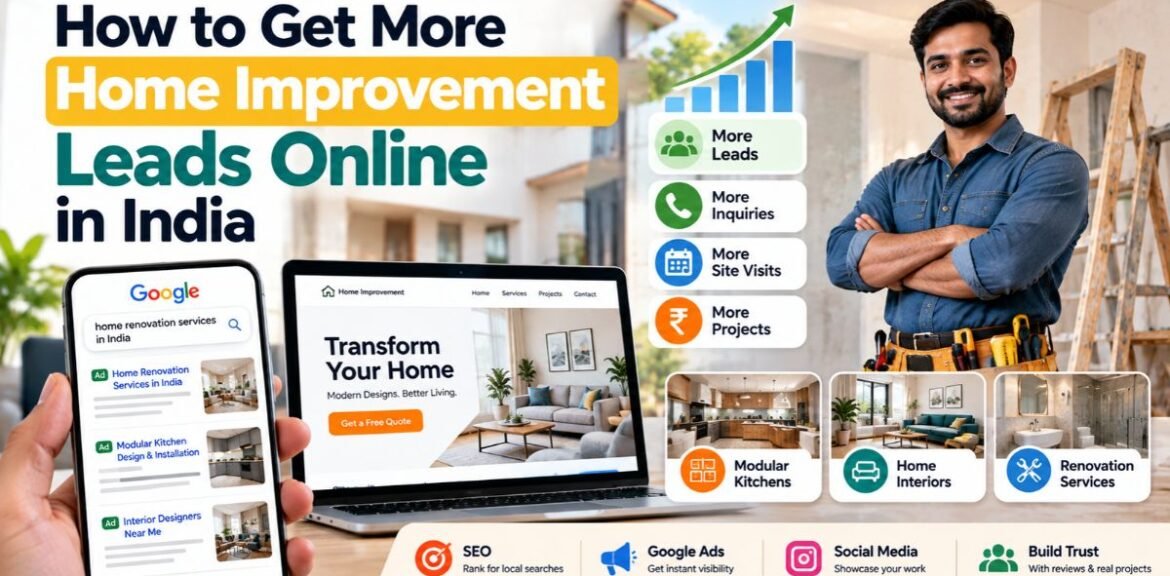

Getting more home improvement leads online is not about a bigger ad budget. It is about building a system where the right channels bring in homeowners with real projects and real budgets, and nothing leaks between the first search and a signed job. Here is how the pieces fit together for a home improvement business in India.
How do home improvement companies get more leads online?
Home improvement companies get more leads by ranking in local search and the Google Map pack, running high-intent Google Ads, using Meta Ads for awareness and retargeting with before-and-after visuals, building trust through reviews, and following up fast so the best enquiries do not go cold. No single channel works alone, the system converts, and fast follow-up decides who wins the job.
Start with intent, not budget
Home improvement demand splits into groups that behave very differently. High-intent homeowners are ready to start and searching for a specific job like bathroom renovation contractor or waterproofing near me. Research-stage homeowners are still gathering ideas and rough costs before they commit. High intent is won with Google Ads and Local SEO. Research stage is won with content and Meta retargeting. Spending on the wrong stage is the main reason home improvement ad budgets feel wasted.
This matters because the two groups need completely different messages. A ready-to-hire homeowner wants your phone number, a clear quote path, and proof you have done the job before. A homeowner still dreaming about a renovation wants ideas, rough costs, and inspiration, and will not respond to a hard sell. Try to force the dreamer to book now and you lose them, ignore the ready buyer with too much education and a competitor grabs them. A working system speaks to each group where they are, then moves them toward an enquiry at their own pace.
The channels that actually bring home improvement jobs
A handful of channels carry almost all qualified home improvement leads. Each has a specific job, and each is covered in depth in its own guide.
- Local SEO and Google Business Profile. Most homeowners search for a service plus their area, so ranking in the Map pack is often the cheapest source of booked jobs.
- Google Ads. Captures homeowners actively searching for the work right now. Highest intent, and the fastest to produce enquiries.
- Meta Ads. Builds awareness and re-engages homeowners planning work, with before-and-after visuals that sell the transformation.
- Reviews and reputation. On a high-value home decision, social proof and project photos often decide which company gets the call.
- Follow-up and qualification. Because the first company to respond usually wins, fast follow-up is where most jobs are actually won or lost.
Fast follow-up is the multiplier most companies ignore
Every channel pays back far more when your leads are answered fast. In home improvement, homeowners contact several companies and hire whoever responds first and inspires the most confidence, so a lead answered in five minutes is worth many times one answered the next day. Yet most businesses let enquiries sit for hours. Instant lead follow-up over call and WhatsApp lifts your win rate without a single extra rupee of ad spend. This is the highest-leverage work in home improvement marketing, and the most overlooked.
Fix the leaks before you scale spend
More budget only multiplies the leaks you already have. The common ones are slow response to enquiries, weak project galleries, a thin review profile, and no tracking, so you cannot tell which channel books jobs. There is no point paying more to send homeowners to a website that does not build confidence, or to a phone that rings out for hours. Fix these first, then scale the channels proven to produce real, qualified enquiries.
A quick way to find your biggest leak is to walk your own funnel as a homeowner would. Search for your service in your city and see where you rank. Click your own ad and time how long a quote takes to submit. Send an enquiry and see how fast, and how well, your team replies. The slowest, weakest step in that journey is usually where most of your money is being lost, and it is almost always cheaper to fix than to out-spend.
Measure cost per booked job, not cost per click
Cost per click and even cost per lead are misleading in home improvement, because many enquiries are price shoppers and only a fraction turn into signed work. The metric that matters is cost per booked job. Track that, and every budget decision becomes obvious, you simply move spend toward what produces real projects, not noise.
Frequently asked questions
Which channel gives home improvement leads the fastest?
Google Ads is usually the fastest, often bringing qualified enquiries within weeks, because it captures homeowners already searching for the work. Local SEO and reviews take a few months to compound but bring the cheapest long-term leads.
How much should a home improvement business spend on marketing?
There is no fixed number, it depends on your service area, job values, and competition. Think in terms of cost per booked job rather than a lump budget, and reinvest in the channels that fill your pipeline with real projects.
Do homeowners really find contractors online?
Yes. Most homeowners search, compare, and shortlist companies online before calling, which is why your local ranking, reviews, and project photos decide who they contact first.
Want this built for your business?
Tycore builds the full home improvement lead system, from ranking and high-intent ads to reviews and instant follow-up, so you get more qualified leads that actually turn into jobs.
→ See how Tycore markets home improvement companies | → Get a free lead audit