

Both work, but for different jobs. Spend on the wrong one and you pay for attention that never books. Here is how to choose.
Should A Car Detailing Studio Run Google Ads Or Meta Ads?
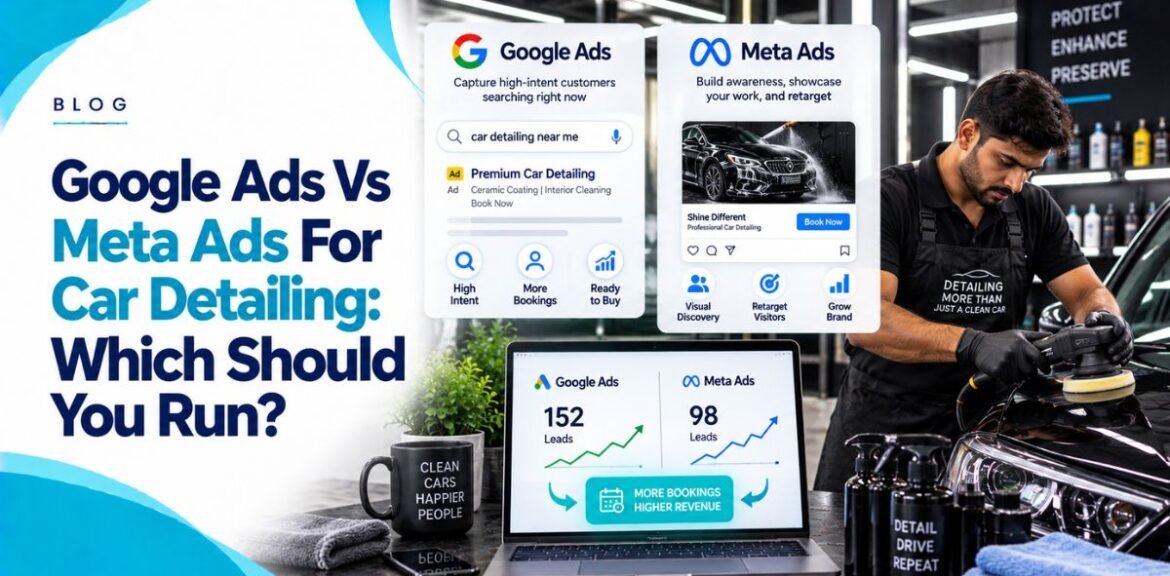
A car detailing studio should usually start with Google Ads to capture high-intent buyers searching for coating and PPF right now, then add Meta Ads to retarget visitors and build demand with before-after content. Google Ads win on immediate intent, Meta Ads win on visual proof and cheaper reach. The strongest results come from running both, with Google capturing demand and Meta creating it.
Also Read:-Car Detailing Services: Ceramic Coating And PPF
The Core Difference
The Google Ads vs Meta Ads question comes down to intent. Google Ads reach people actively searching for what you sell, high intent, ready to book right now. Meta Ads reach people scrolling who are not searching yet, lower intent, but far cheaper to reach and perfect for visual proof. Neither is better, they do different jobs in a detailing funnel, and the studios that grow fastest usually stop treating it as a choice and use each for what it does best.
When Google Ads Win
- You want bookings now, someone typing ceramic coating near me is ready to buy.
- You sell high-ticket services where one PPF job pays for weeks of ad spend.
- You can write tight campaigns with negatives to block free-wash and price-shopper searches.
The downside: clicks are more expensive and budgets deplete fast if targeting is loose.
Also Read:-How To Stop Getting Price-Shopper Car Wash Leads
When Meta Ads Win
- You have strong before-after visuals that stop the scroll.
- You want to retarget people who visited your site or Profile but did not book.
- You want cheap brand awareness between a car owner’s purchase cycles.
The downside: intent is lower, so Meta rarely delivers same-week bookings on its own.
The Setup We Recommend For Most Studios
- Run Google Ads on high-intent coating and PPF keywords with a tight negative list, this captures buyers now.
- Install the Meta pixel and retarget every Google visitor who did not book with before-after creative.
- Add a small Meta prospecting budget with your best transformation reels to fill the top of funnel.
- Track cost per booked job, not cost per click, and shift budget toward whichever books the high-ticket work.
Budget Split To Start
For a studio focused on coating and PPF, a common starting split is roughly 60 to 70 percent to Google Ads for capture and 30 to 40 percent to Meta Ads for retargeting and proof. Adjust based on your real cost per booked job, not gut feel.
Also Read:-How To Get More Car Detailing Customers
How To Structure A Google Ads Campaign For Detailing
Loose campaigns are why most studios say ads did not work. A tight structure changes the result.
- Separate campaigns or ad groups for ceramic coating, PPF, and general detailing, each with its own keywords and copy.
- A strong negative keyword list from day one, block free, cheap, DIY, and job or salary searches.
- Location targeting limited to a realistic service radius, not the whole city if you cannot serve it.
- Call and location extensions, plus a landing page that matches the search, not your homepage.
Common Mistakes With Detailing Ads
- Sending all traffic to the homepage instead of a service-specific page, which tanks conversions.
- Judging Meta Ads by immediate bookings when their job is proof and retargeting.
- Pausing campaigns every few days, which resets learning and wastes budget.
- Running ads with no tracking, so you never learn your real cost per booked job.
Get the structure and tracking right and the Google Ads vs Meta Ads debate stops being either-or, each does its job and the pipeline fills with the right work.
Also Read:- Car Detailing Digital Marketing
The Numbers That Actually Decide The Winner
Do not judge either platform on surface metrics. Impressions, reach, and clicks tell you nothing about revenue. Set up conversion tracking so every enquiry is tied to the channel that produced it, then compare on what matters.
- Cost per booked job by channel, the single number that decides where budget goes.
- Share of coating and PPF enquiries each channel produces, not just total leads.
- Return on ad spend measured against real job value, not click volume.
Reviewed monthly, these numbers tell you exactly how to rebalance your Google Ads and Meta Ads spend, no guesswork required.
Also Read:- Local SEO For Car Detailing Studios
Frequently Asked Questions
Meta clicks are usually cheaper, but Google clicks convert to bookings at a higher rate because intent is higher. Compare on cost per booked job, not cost per click.
Yes. If budget is tight, start with Google Ads for immediate high-intent bookings, then add Meta retargeting once you have traffic to retarget.
Enough to gather data, typically a sustained monthly budget over at least 8 to 12 weeks. Stopping and starting resets learning and wastes spend.
Ads amplify what you already have. If your Profile is thin and your site does not convert, fix those first or ads will underperform.
Not Sure How To Split Your Ad Budget?
We build and manage Google and Meta campaigns for detailing studios, tuned to book coating and PPF jobs, not clicks.
Book Your Free Detailing Marketing Audit
Pingback:How To Stop Getting Price-Shopper Car Wash Leads
Pingback:Marketing High-Ticket Detailing Services: