

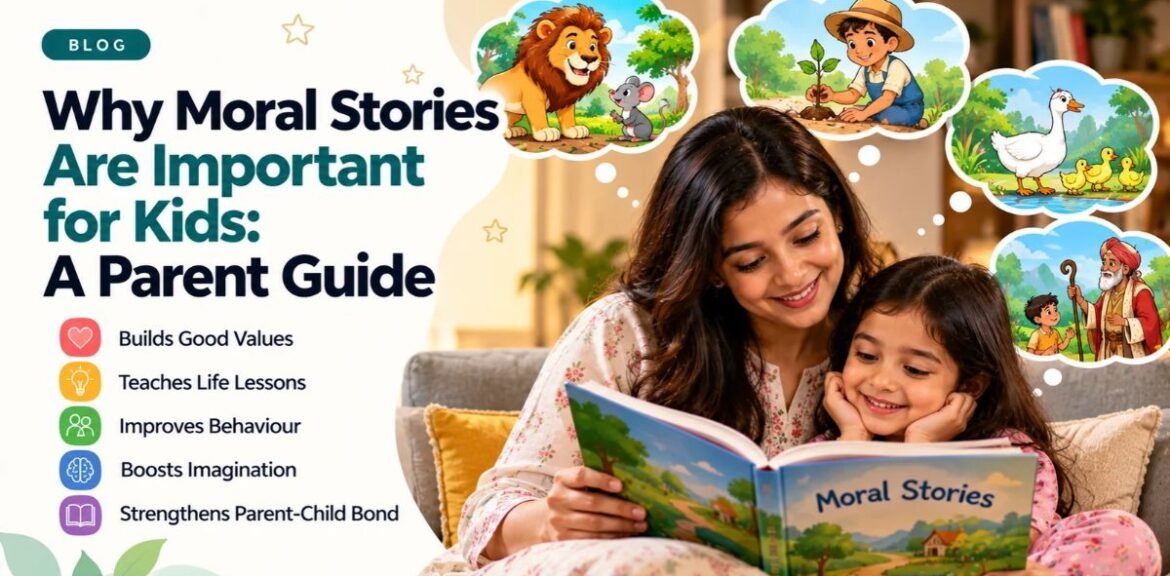

Long before formal lessons on values and ethics, children learn what is right and wrong through stories. Moral stories remain one of the most effective, time-tested tools for building character in young children.
In this guide, we explore why moral stories matter so much and how parents can use them effectively.
1. Teaches Values Without Direct Lecturing
Children often resist direct instructions about behaviour but absorb the same lessons naturally when presented through an engaging story and relatable characters.
A story lets a child discover a lesson themselves, which tends to stick far longer than being told directly what to think or do.
2. Builds Empathy and Perspective-Taking
Following a character’s journey and choices helps children understand different perspectives and emotions, building early empathy skills.
3. Develops Critical and Reflective Thinking
Discussing a story’s outcome and lesson encourages children to think critically about choices and consequences, beyond just memorising a moral.
4. Strengthens Language and Listening Skills
Moral stories, often rich in vocabulary and narrative structure, support language development alongside their ethical lessons.
5. Creates Positive Bonding Time
Story time, especially at bedtime or during quiet moments, creates valuable parent-child connection alongside the educational value.
How to Make the Most of Moral Stories at Home
Choose Age-Appropriate Stories
Select stories with lessons and complexity matching your child’s age and understanding, starting simple and building up over time.
Discuss, Don’t Just Read
After the story, ask open questions: “What do you think the character should have done?” This deepens the learning beyond passive listening.
Revisit Stories Regularly
Repetition helps values sink in over time. Don’t hesitate to read favourite stories again, even months later.
Common Mistakes Parents Make
- Explaining the moral immediately instead of letting the child reflect first
- Choosing stories that are too complex or too simple for the child’s current age
- Rushing through story time without pausing for discussion
When Should Moral Story Time Begin?
Moral stories can begin as early as age 3, with complexity and depth increasing gradually as children grow through the primary school years.
FAQ
They teach values naturally through relatable characters, build empathy, develop critical thinking, and support language skills, all without direct lecturing.
Choose age-appropriate stories, discuss the lesson afterward by asking open questions, and revisit favourite stories regularly to reinforce values.
Yes, following a character’s journey and choices helps children understand different perspectives and emotions.
Moral stories can begin as early as age 3, with complexity increasing gradually as children grow.
It’s better to ask your child what they think first, letting them reflect and arrive at the lesson themselves before guiding them further.