
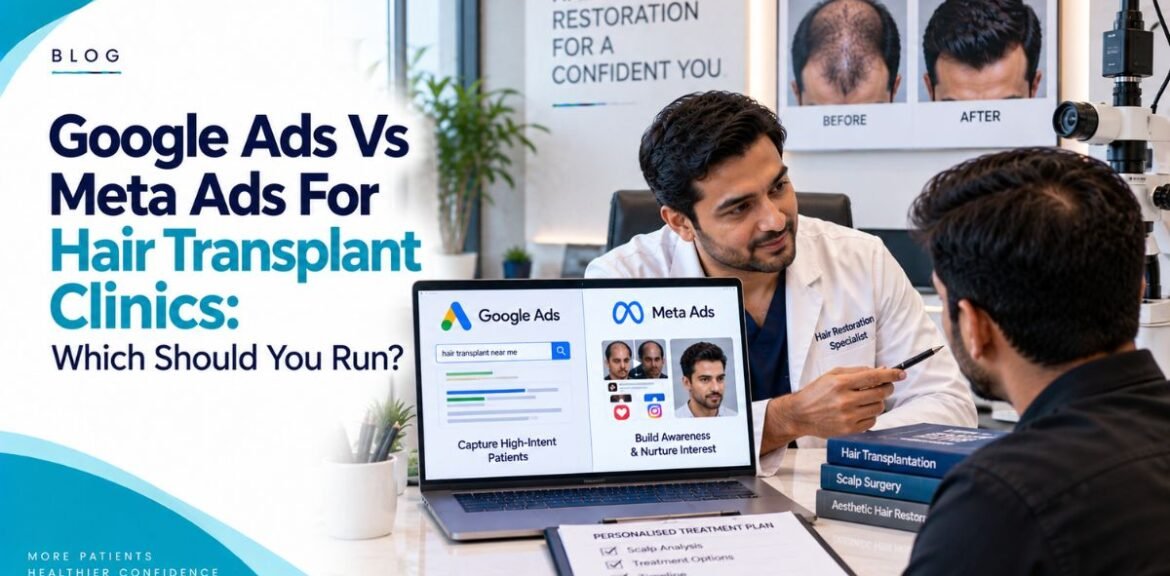

Most hair transplant clinics ask the same question: Google Ads or Meta Ads? The honest answer is that they do different jobs. Google captures patients already searching; Meta creates demand among people worried about hair loss. Here is how to decide where your budget should go.
Google Ads Or Meta Ads For Hair Transplant Clinics?
For hair transplant clinics, Google Ads works best for capturing patients who are already searching for a hair transplant and are close to deciding, while Meta Ads works best for creating demand among people worried about hair loss who are not searching yet. Google leads cost more but convert faster; Meta leads are cheaper but need stronger qualification and follow-up. Most clinics get the best result running both together, with the split set by budget, city competition, and how quickly they need consultations.
How Google Ads Works For Hair Transplant
Google Ads is intent capture. When a patient searches “hair transplant in [city]” or “FUE cost”, your ad appears at the moment they are actively deciding. That intent is why Google leads convert faster into consultations. The catch is cost: hair transplant is a high-value, competitive keyword, so clicks in metros are expensive. It is the right channel when you need consultations now and can afford a higher cost per click for higher intent.
How Meta Ads Works For Hair Transplant
Meta Ads is demand creation. Facebook and Instagram put your clinic in front of people by city, age, and interest, before they have started searching. You reach the large group who are quietly worried about hair loss but have not acted yet. Leads are cheaper, but they are earlier in the journey, so they need firmer qualification and faster follow-up. Meta also restricts before-after images and certain health wording, so creative must be built to pass review.
Cost And Lead Quality: The Honest Comparison
The trade-off is almost always the same:
- Google Ads: Higher cost per lead, higher intent, faster consultations, tighter volume.
- Meta Ads: Lower cost per lead, lower intent, more volume, more qualification needed.
This is why comparing raw cost per lead across the two is misleading. A cheaper Meta lead that never books is more expensive than a costlier Google lead that does. Judge both on cost per qualified consultation instead.
Which Channel For Which Situation
- Immediate Demand: Need consultations this month and have budget: lead with Google Ads.
- New Clinic: New clinic building awareness in a city: lead with Meta Ads.
- Small Budget: Tight budget, want only high-intent patients: start narrow on Google Ads.
- Strong Creative: Strong results, credibility, and policy-safe creative: scale Meta Ads.
Why Running Both Usually Wins
The two channels feed each other. Meta creates awareness and demand, and when those people later search, Google captures them. Remarketing ties it together, showing your clinic again to patients who engaged but did not book. For most clinics with a working budget, a Google plus Meta combination beats either alone.
What To Watch On Both Channels
Track cost per qualified consultation, not cost per lead. Watch for ad disapprovals, which stall spend and skew results, and keep follow-up instant, because both channels leak patients when the first response is slow. The channel matters less than the system around it.
A Simple Way To Split Your Budget To Start
If you are starting from scratch, a common approach is to put the larger share into Google Ads for immediate, high-intent consultations, and a smaller share into Meta Ads to build awareness and feed remarketing. As real data comes in, shift budget toward whichever channel is producing the lower cost per qualified consultation in your city. The right split is never fixed. It moves with your results, your season, and how aggressive the competition is that month, so treat it as something you tune, not set once.
Frequently Asked Questions
Meta is usually cheaper per lead because it reaches people earlier. But Google often wins on cost per qualified consultation because those leads are searching with real intent. Cheaper per lead is not the same as cheaper per patient.
It varies widely by city, procedure value, and competition, so a single benchmark is misleading. The number that matters is cost per qualified consultation, which we scope against your city and targets in a free audit.
Before-after images are restricted under Meta’s health and personal-attribute policies and are a common cause of rejection. There are compliant ways to show credibility and results instead, covered in our ad-compliance guide.
Enough to gather real data across a few weeks rather than a token amount that never exits the learning phase. The right starting figure depends on your city and consultation targets.
Not Sure How To Split Your Ad Budget?
Tycore builds and runs Google and Meta campaigns tuned to booked consultations, with the split set to your city and targets. Get a free lead audit and we will map it out.
Talk To Tycore About Hair Transplant Clinic Marketing | Get A Free Lead Audit