

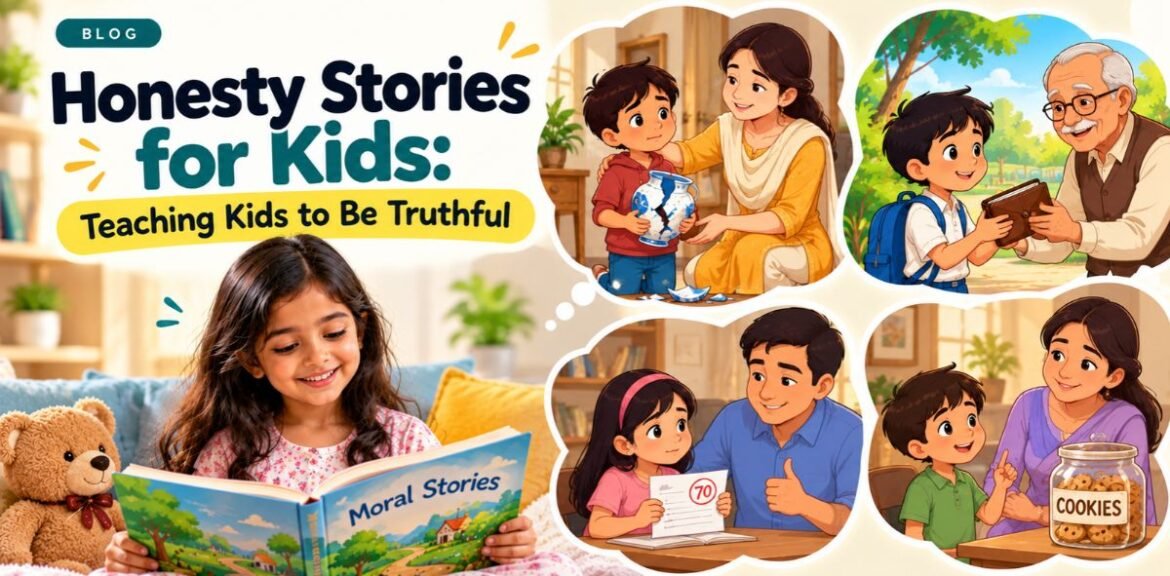

Honesty is one of the most important values parents want to instil in their children, and stories offer a natural, effective way to teach this lesson without direct lecturing.
In this post, we share great honesty-themed stories and how to use them to build truthfulness in your child.
Why Honesty Stories Work So Well
Stories let children see the consequences of both honesty and dishonesty play out through a character, making the lesson concrete and memorable rather than abstract.
Children often relate more to a character’s mistake and growth than to being told directly not to lie.
Great Honesty Stories to Share
The Honest Woodcutter
A woodcutter is rewarded for honestly admitting his axe fell into the river, rather than falsely claiming the golden or silver axes offered to him.
The Boy Who Cried Wolf
A shepherd boy who repeatedly lies about a wolf attack loses everyone’s trust, and no one believes him when a real wolf finally appears.
How to Teach Honesty Through Stories: Step by Step
Step 1: Read the Story Together
Read the story with full engagement, using expressive voices to bring the characters to life.
Step 2: Discuss What Happened and Why
Ask your child: “What happened when the character was honest?” and “What happened when they lied?” Let them draw the comparison themselves.
Step 3: Connect to Real Life
Gently ask if your child has ever faced a similar choice between telling the truth and not, without making them feel accused or judged.
Step 4: Praise Honesty When You See It
When your child tells the truth, even about a mistake, acknowledge and praise the honesty specifically, reinforcing the value in real moments.
Common Mistakes Parents Make
- Punishing honesty about a mistake as harshly as the mistake itself
- Only discussing honesty after a lying incident rather than proactively through stories
- Rushing through the story without pausing for reflection
At What Age Should Honesty Stories Be Introduced?
Honesty stories are suitable from age 3 onward, since understanding the difference between truth and lies begins developing early in childhood.
FAQ
The Honest Woodcutter and The Boy Who Cried Wolf are excellent classic stories that clearly illustrate the value of honesty and the consequences of lying.
Stories show the consequences of honesty and dishonesty through characters, making the lesson concrete and memorable rather than a direct lecture.
Discuss what happened in the story, ask your child to compare the honest and dishonest outcomes, and gently connect it to real life if appropriate.
Honesty stories are suitable from age 3 onward, as understanding truth versus lies begins developing early in childhood.
It’s better to praise the honesty of admitting the mistake, which encourages continued truthfulness rather than fear of confessing in the future.