

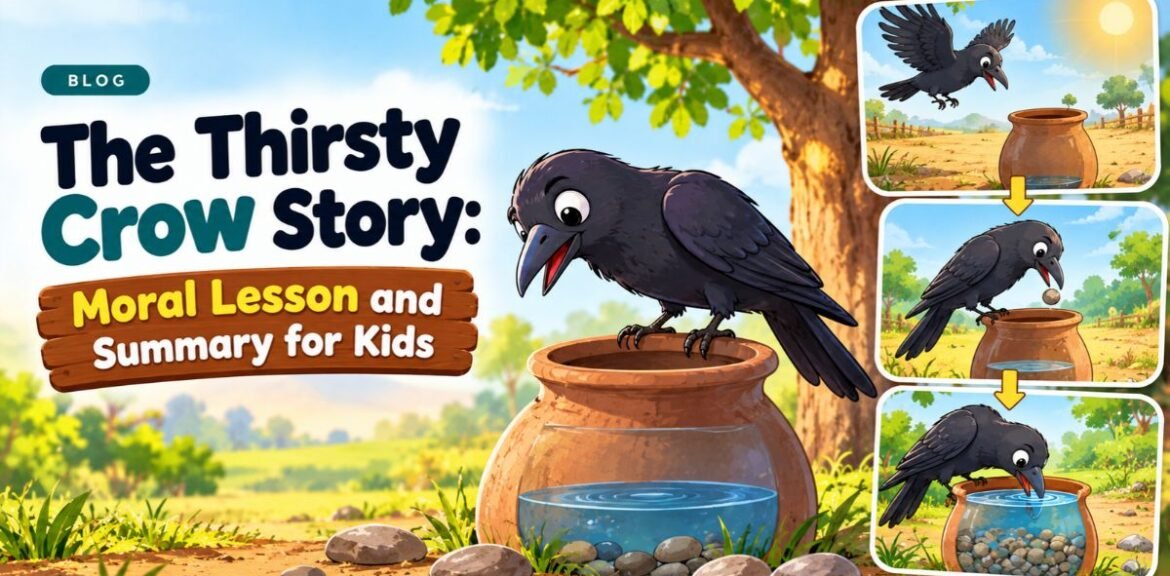

The Thirsty Crow is one of the most beloved classic stories for children, teaching a simple but powerful lesson about patience and clever problem-solving.
In this post, we share the story summary along with its moral lesson and how to discuss it with your child.
The Thirsty Crow: Story Summary
On a hot summer day, a thirsty crow flew for a long time searching for water. Finally, it found a jug with a little water at the bottom, but the neck of the jug was too narrow for its beak to reach the water.
The clever crow noticed some pebbles nearby. One by one, it picked up pebbles and dropped them into the jug. Slowly, the water level rose higher and higher until finally the crow was able to drink and quench its thirst.
The Moral Lesson
The story teaches that intelligence and patience can solve problems that seem impossible at first. Instead of giving up, the crow used clever thinking to find a solution, teaching children about perseverance and creative problem-solving.
Ask your child: “What would you have done if you were the crow?” This encourages them to think through the problem themselves.
How to Discuss This Story With Your Child
Ask What the Crow Could Have Done Differently
This opens a discussion about other possible solutions, encouraging flexible thinking beyond just the story’s answer.
Connect to a Real-Life Example
Ask your child to think of a time they solved a tricky problem by thinking carefully, connecting the story’s lesson to their own experience.
Discuss the Value of Not Giving Up
Talk about how the crow could have simply flown away, but instead kept trying until it found a solution.
Fun Ways to Extend This Story
- Try a simple science experiment showing water displacement with pebbles and a glass.
- Ask your child to draw their favourite part of the story.
- Act out the story together, taking turns being the crow.
At What Age Is This Story Suitable?
The Thirsty Crow is a simple, well-loved story suitable for children as young as age 3, with its short length and clear lesson.
FAQ
The story teaches that intelligence and patience can solve difficult problems, encouraging perseverance rather than giving up.
A thirsty crow finds water in a narrow jug it cannot reach and cleverly drops pebbles in to raise the water level so it can drink.
Ask what the crow could have done differently, connect the lesson to a real problem your child solved, and discuss the value of not giving up.
This story is suitable for children as young as age 3, given its short length and clear, simple lesson.
A simple water displacement experiment with pebbles, drawing a favourite scene, or acting out the story all pair well with this classic tale.